
ADHD affects attention, impulse control, and the ability to stay organized. These challenges often influence school performance, work routines, relationships, and day-to-day life. Neurofeedback for ADHD offers a way to train the brain toward steadier patterns by providing real-time information about its electrical activity. This brain-based method has gained interest among individuals who want additional support for ADHD symptoms or are seeking options that do not rely solely on medication.
Here we explain how neurofeedback training works, how it relates to ADHD symptoms, and what current research suggests about EEG neurofeedback, SCP neurofeedback, and other protocols used to support attention and behavior.
ADHD involves differences in how the brain regulates attention and organizes information. These patterns may create difficulties with focus, task completion, follow-through, and impulse control. Although symptoms vary from person to person, common experiences include:
Brain imaging studies have shown that ADHD often involves irregular activity in regions responsible for executive function, planning, and regulation. These irregular rhythms can make it harder to maintain steady attention or shift between tasks efficiently.
Neurofeedback for ADHD is rooted in the idea that when individuals can observe and gradually adjust these electrical patterns, the brain learns steadier responses. Instead of targeting only behaviors, neurofeedback focuses on the internal signals that contribute to those behaviors.
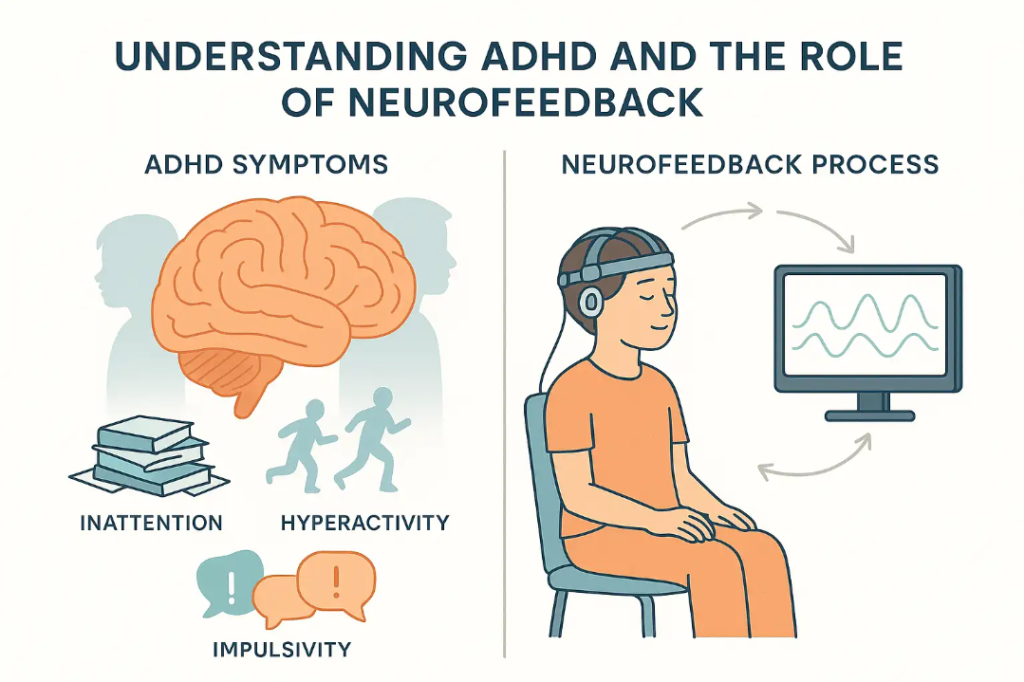
Neurofeedback training uses sensors placed on the scalp to measure electrical activity. The system translates this activity into visual or audio cues that help the brain learn to self-correct. When the brain moves toward a more suitable pattern for attention and regulation, the feedback reinforces that shift. With repetition, these new patterns can become easier for the brain to access during daily life.
For ADHD, this process is meaningful because symptoms often stem from inconsistent control within networks that manage focus and behavioral responses. Training sessions give the brain practice in staying within more regulated ranges.
Individuals may notice improvements such as:
Neurofeedback training does not require individuals to perform cognitive tasks during the session. The system works with the brain’s natural signals, making the process accessible for children, teens, and adults.
A variety of neurofeedback protocols have been studied for treating ADHD. EEG neurofeedback is the most widely researched and focuses on brainwave patterns linked with attention and behavioral control. This method has been evaluated in reviews, clinical studies, and long-term trials, with many noting improvements in focus, inhibitory control, and overall daily function.
Common approaches include:
Each protocol works differently, and providers often choose a method based on a patient’s unique symptoms or assessment results. Some clinicians use a combination of these approaches to support both cognitive and behavioral goals.
Current research continues to examine how different neurofeedback effects relate to ADHD subtypes. Studies involving children and adults show promising outcomes, particularly when interventions are tailored to the individual and adjusted over time.
Neurofeedback for ADHD is often integrated with other supports rather than used on its own. Because ADHD influences learning, behavior, and emotional responses, a coordinated plan tends to offer the strongest results.
Neurofeedback may be used alongside:
Training the brain through neurofeedback sessions can help individuals make better use of these tools. For example, improved attention may make schoolwork or behavior strategies easier to apply. Adults may find that clearer focus supports productivity and emotional steadiness throughout the day.
This integrated approach also allows providers to monitor progress from several angles. When changes in brain activity are paired with behavioral improvements, treatment plans can be refined to support continued growth.
A growing body of research highlights the potential benefits of neurofeedback for ADHD. Clinical reviews and meta-analyses indicate that many individuals experience improvements in attention, inhibitory control, and symptom management after completing a series of training sessions. Some studies also report durable effects that continue after treatment ends, suggesting that neurofeedback may help the brain maintain new patterns over time.
Research on SCP neurofeedback and innovative EEG biofeedback approaches continues to evolve. These trends reflect increasing interest in personalized protocols that target the neurological features of ADHD rather than relying on a single universal method.
Although responses vary, studies support the idea that neurofeedback offers a promising pathway for individuals seeking additional support beyond medication or behavioral therapy alone. Its noninvasive nature and focus on brain-level regulation make it an appealing option for many families and adults navigating ADHD.
Neurofeedback for ADHD provides a structured method of training brain activity related to focus, behavior, and emotional responses. By offering real-time feedback, it helps the brain practice steadier patterns that may support better attention and daily functioning. While not a replacement for established ADHD treatment, neurofeedback can be a helpful addition to a personalized plan that includes therapy, school or work support, and structured routines. If you would like to understand how neurofeedback may fit into your care or your child’s care, Carolina Hyperbaric and Wellness can provide information, assessments, and guidance on available training options. Their team can help you learn what to expect from the process and how it may support your goals for improved focus and well-being.
behavior, medication, therapy, neurofeedback, attention deficit hyperactivity disorder, mental health, does neurofeedback work for adhd, electroencephalography, psychiatry, brain, impulsivity, stimulant, biofeedback, clinical trial, research, effect size, cognition, parent, efficacy, working memory, alternative medicine, anxiety, health, frequency, information, memory, adult attention deficit hyperactivity disorder, psychology, bias, patient, substance abuse, systematic review, disease, neuroscience, statistical significance, treatment, executive functions, teacher, study heterogeneity, risk, confidence interval, learning, inhibitory control, database, stress, neuroplasticity, statistic, american psychiatric association, evidence, human, data, neuropsychology, placebo, reinforcement, exercise, cerebral cortex, pubmed, adhd biofeedback treatment, neurofeedback therapy and adhd, adhd neuro feedback, bio feedback adhd, neurofeedback and adhd, mental health professional, effective, program, management, health professional, communication, mental wellness, patient forms, achieve, depression, mental, attention, wellness